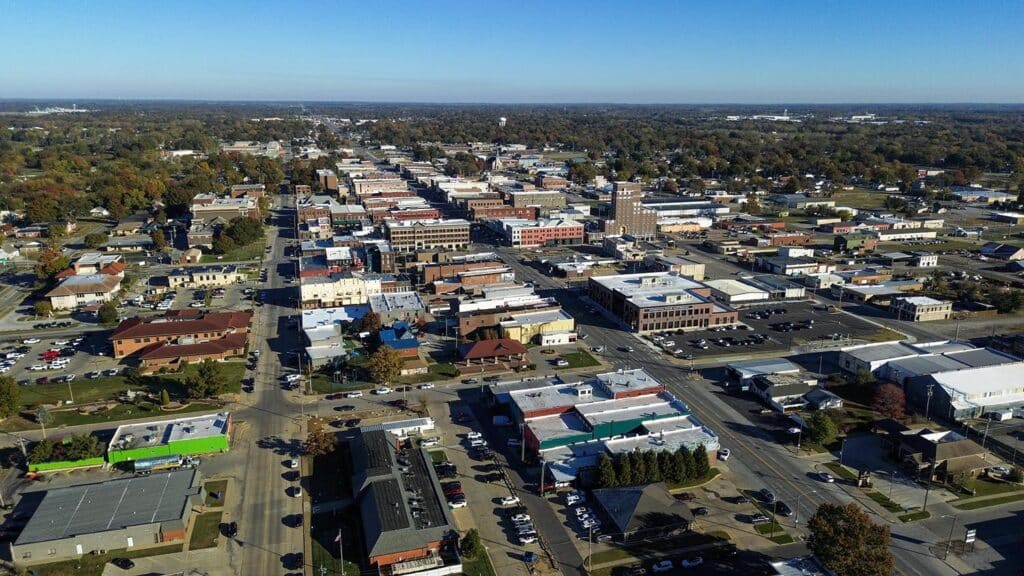
According to the most recent Pittsburg Micropolitan Area Economic Report created by Pittsburg State University’s Business & Economic Research Center, Pittsburg has a vibrant economy, and Downtown Pittsburg is thriving.
The cost of living in Pittsburg is only 82.5 percent of the national average. What this means is, on average, everyday expenses in Pittsburg are approximately 17.5 percent lower than the U.S. average. Residents’ dollars tend to go further on major costs such as housing, utilities, groceries and services.
Job growth is also up 1.4 percent, surpassing Kansas’s rate of 0.4 percent and the national rate of 0.2 percent. Since 2020, Pittsburg’s population has increased by 4.5 percent, and median hourly wages have increased by 44.1 percent. The unemployment rate is steady.
The City of Pittsburg, the Pittsburg Area Chamber of Commerce, and Pittsburg State University have promoted significant economic development efforts in the downtown area.
“Downtown is the most prominent symbol for quality of life in a micropolitan city,” said Michael Davidsson, Professor of Economics and Director of the Business and Economic Research Center. “Downtown is the heart of the local community and a powerful symbol of the local quality of life. When people and firms consider moving to a city, they like to see a vibrant downtown but become discouraged by a dilapidated or underutilized downtown.”
Pittsburg provides several meaningful incentives to promote housing and downtown development. This includes the Reinvestment Housing Incentive District (RHID) program to promote housing development; the City Housing Incentive Program (CHIP), which provides cash to builders upon occupancy certification; direct contributions averaging 10 percent of the Economic Development Sales Tax to worthy economic development projects; and many other valuable incentives.
Placer.ai reports 1,170,431 visits to downtown Pittsburg during the first eight months of 2026 (up 10.6 percent from the same period in 2025). Approximately 50.3 percent of the downtown visits were by people living in Pittsburg; 14.9 percent were by people living in the Pittsburg micropolitan area but outside the city of Pittsburg; 19.2 percent were from within Kansas but outside the micropolitan area; and 15.6 percent were from outside of Kansas.
Downtown retail is doing well, according to the Kansas Department of Revenue. There are nearly 30 small specialty retailers in downtown Pittsburg, along with more than 20 places to eat and drink, including several restaurants, coffee shops, bars, and cocktail lounges. Pittsburg’s downtown district also continues to add insurance services, real estate agencies, healthcare and wellness clinics, law firms, beauty salons and corporate office spaces.
The latest information from the Kansas Department of Revenue shows that taxable sales increased to $234.8 million in Pittsburg during the first six months of 2026, up 3.5 percent from the first six months in 2025.
The downtown area is also growing in population thanks to several loft-style apartments and upper-story living spaces. Additionally, across Pittsburg, a total of 19 new single-family permits were issued in the City of Pittsburg during the first nine months of 2026, for a stated value of $4.7 million (up 125.7 percent from the same period in 2025), seven new multi-family permits were issued with a stated value of $1.7 million, and 63 permits were issued for additions, alterations and conversions.
With multiple school options, a satisfying array of amenities, and a low cost of living, Pittsburg has long been attractive to families, but a strong local job market, expanding entertainment options, and exceptional broadband internet have increasingly attracted young professionals and retirees. New downtown apartments, housing redevelopment in existing neighborhoods, and greenfield development have created an array of housing options attractive to people in all stages of life.
Commercial permits also increased in 2026, with a stated value of $3.98 million (up 82 percent from the same period in 2025).
“This growth reflects the collective effort and strong partnerships across our community,” City Manager Daron Hall said. “Those combined efforts demonstrate our shared commitment to making Pittsburg a great place to live.”